Drywood termite spot treatment provides defensive, contained elimination of colonies nesting entirely within dry structural lumber. In South Florida, the invasive West Indian drywood termite ( Cryptotermes brevis )…
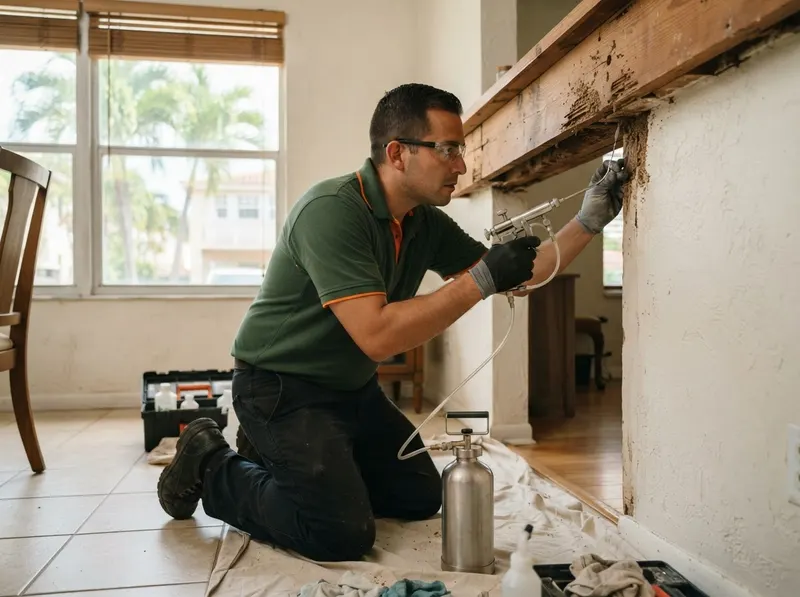
Drywood termite spot treatment provides defensive, contained elimination of colonies nesting entirely within dry structural lumber. In South Florida, the invasive West Indian drywood termite (Cryptotermes brevis) infests door jambs, attic rafters, and hardwood floors without requiring contact with the soil. Unlike whole-structure fumigation using sulfuryl fluoride gas, localized spot treatment allows homeowners to remain inside the residence throughout the process. Technicians at CedarShield Exterminators drill microscopic access ports directly into active termite galleries identified via fiber-optic borescopes and acoustic detection. Formulations containing mineral borates derived under standards outlined by the Environmental Protection Agency are then injected under calibrated pressure to permeate the gallery network, creating an inorganic barrier that disrupts termite digestion and provides lingering protective toxicity.
Local architectural conditions across Miami-Dade County dictate precise placement of spot treatments. Historic Mediterranean revival homes near Coral Way and 1920s pine cottages in Coconut Grove frequently contain dense Dade County slash pine framing that resists generic broad-spectrum sprays. These hard, resinous woods require pressurized internal injection to reach deep internal galleries. Similarly, high-rise condominiums in Brickell and Edgewater, alongside dense mixed-use lofts in Wynwood, face strict structural limitations where chemical tenting is prohibited by condominium associations or physical proximity to adjacent structures. For single-room infestations identified near the Calle Ocho Walk of Fame in Little Havana or residential properties in Allapattah, Overtown, and the Upper Eastside, localized localized treatment neutralizes targeted nests before colonies disperse swarming alates into untouched rooms.
Spot treatment serves as the correct clinical option when termites occupy an accessible, clearly delimited area measuring fewer than 15 to 20 linear feet of timber, such as an isolated baseboard, a single window buck, or exposed tongue-and-groove ceiling planking. The primary trade-off is geographic scope versus disruption: localized injections preserve daily home occupancy and keep botanical, pet-friendly protections in place, but they cannot treat hidden colonies inside sealed wall cavities that diagnostic sensors cannot reach. When structural inspections reveal diffuse, multi-level gallery systems spread across inaccessible roof trusses, whole-house structural remedies become necessary. Technicians follow application protocols aligned with guidance from the Florida Department of Agriculture and Consumer Services to ensure chemical containment within treated members.
To prepare a residence for spot intervention, clear 3 feet of clearance around the affected woodwork. Technicians map gallery voids, inject the active mineral borate or botanical termiticide, seal drill ports with matching wood patches, and vacuum away hex-shaped frass piles to establish a clean baseline for monitoring. Homeowners can reach CedarShield Exterminators directly at (786) 947-6281 to review localized inspection availability across Miami neighborhoods, or arrange to text a photo of collected wood droppings for immediate confirmation.
Every job gets a firm, written price after a free on-site visit.
For standards, safe disposal, and service guidance on pest control services in Miami, FL, useful references include U.S. EPA, ENERGY STAR, U.S. Dept. of Energy, Consumer.gov, U.S. Census Bureau, and Google Maps. General consumer and small-business resources are available from USA.gov, Better Business Bureau, FTC Consumer Advice, U.S. Small Business Administration, and Ready.gov.
Tell us about your drywood termite spot treatment job in Miami and we'll send a clear, written quote, usually the same day.
 CedarShield Exterminators